The Weirder the Workout, the More We Trust It: Inside America's Boutique Fitness Spiral
Let's establish something right away. You were fine. You had a gym membership, a pair of New Balances with maybe forty miles on them, and a vague intention to use both more often. Life was imperfect but manageable.
Then someone in your friend group tried something called Neuro-Kinetic Suspension Flow, paid $185 for the intro session, and described it as "genuinely life-changing" with the glazed conviction of someone who has just joined a very athletic cult. And now here you are, two weeks later, walking like a baby deer on a frozen pond and swearing it's because your deep stabilizer muscles are "finally being activated for the first time in your adult life."
Welcome to the boutique fitness industrial complex. Population: all of us, apparently.
The Price Tag Is the Point
Here's the thing nobody wants to say out loud but everyone instinctively understands: we have collectively decided that cost equals credibility. A $12-a-month gym membership feels suspicious. A $34-per-class reformer pilates studio with exposed brick walls and a Spotify playlist that costs more to license than your rent? That feels like medicine.
This is not rational. This is also completely understandable.
We live in a country where healthcare is confusing, sleep is optional, and stress is treated as a personality trait. So when a studio promises to "restore your fascia," "reset your nervous system," and "unlock the movement patterns your ancestors forgot," the $200 price point doesn't scare us — it reassures us. Surely nobody would charge that much for something that didn't work. Surely.
Spoiler: they would. They absolutely would. And we will pay it.
A Brief Tour of Things We're Now Doing to Our Bodies
Let's take a moment to appreciate the sheer creativity of the boutique fitness world, because honestly, respect where respect is due.
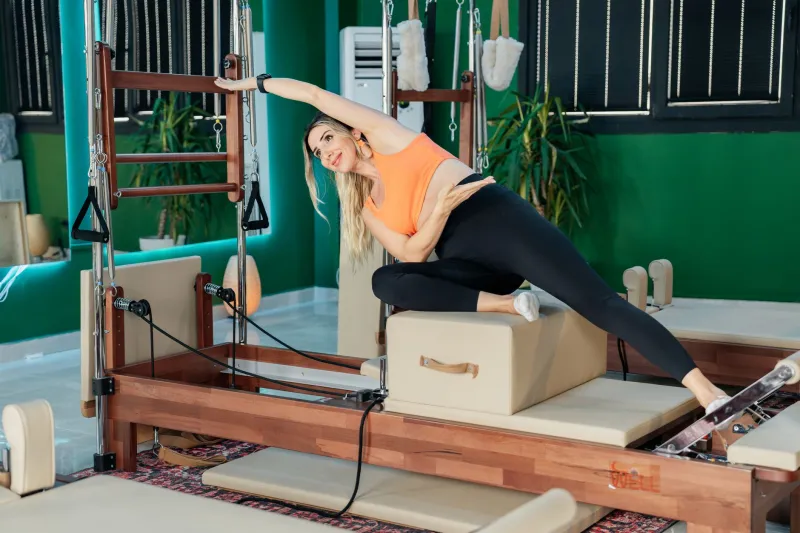
Reformer Pilates started it. A machine that looks like it belongs in a Victorian rehabilitation ward, operated by a very calm instructor who whispers instructions like "find your powerhouse" while you silently wonder what a powerhouse is and whether yours is broken.
Then came bungee cardio, which is exactly what it sounds like — strapping yourself to a bungee cord attached to the ceiling and doing lunges while your body argues with physics. Classes routinely sell out. People describe it as "freeing." The waiver you sign is three pages long.
Aerial silks fitness followed, promising the grace of a Cirque du Soleil performer and delivering, for most of us, the grace of laundry tangled in a ceiling fan.
Somewhere along the way, goats got involved in yoga, which was charming and chaotic and led to a logical extension: equine-assisted movement therapy, which is yoga-adjacent mindfulness conducted near horses who are not participating but are being billed for the ambiance.
And now we have functional movement realignment, which is the newest iteration — a genre of workout so vague in its description that studios can charge premium rates while remaining technically unfalsifiable. Did it work? Well, define "work." Did your glute medius "re-pattern"? How would you even know if it didn't?
Why Normal Exercise Stopped Being Enough
Running is free. Push-ups are free. A brisk walk costs nothing and, according to every longevity researcher alive, is one of the most effective things you can do for your body. So why are we instead booking 45-minute "vibrational resistance" sessions at studios with names like Kinetic Bloom and The Movement Atelier?
Two reasons, and they're both deeply human.
First: novelty feels like progress. When you try something new and your muscles hurt in places you didn't know existed, your brain interprets that as evidence of transformation. Regular soreness from a regular workout? Boring. Soreness in your "anterior tibialis stabilizer chain" after a $175 class? That's growth, baby. That's your body changing on a cellular level. (It is not. It is DOMS. It is regular muscle soreness with better branding.)
Second: community and identity. The boutique fitness studio isn't just selling a workout. It's selling a tribe, an aesthetic, a version of yourself that wakes up at 5:45 AM with intention and owns matching sets of moisture-wicking athleisure. The Instagram post after class isn't vanity — it's membership dues. You paid $200. You are going to tell someone.
The Instructor Is Always Inexplicably Serene
One consistent feature across every niche fitness experience is the instructor, who exists in a permanent state of glowing, effortless calm that feels biologically impossible. They demonstrate the movement perfectly, they use phrases like "honor your edge" and "breathe into the resistance," and they appear to be operating on a different plane of physical reality than the rest of the class.
You, meanwhile, are gripping a foam roller like it's a life preserver, sweating through fabric that specifically promised not to trap sweat, and trying to remember if your health insurance covers whatever you just did to your hip flexor.
The instructor smiles. "Beautiful," they say, looking directly at you. You have not done anything beautiful. You have done something that a physical therapist might describe as "concerning." But you nod, because $200 bought you the right to feel seen.
Are We Crazy Or What?
Here's the honest answer: not entirely.
Because here's what the boutique fitness spiral gets right, even when it gets everything else wrong — it gets people moving. If a $40 bungee cardio class is the thing that finally makes someone exercise consistently, then the bungee cardio class did its job, absurdity and all. If reformer pilates makes your back hurt less, the Victorian torture machine earned its keep.
The problem isn't the movement. The movement is good. The problem is the mythology — the idea that regular, boring, free exercise is somehow insufficient. That your body requires increasingly exotic interventions to function properly. That wellness is a premium product available only to people who can afford to strap themselves to a ceiling on a Tuesday evening.
Most of us don't need our fascia restored. We need to walk more and sit less and drink some water. But "walk more and drink some water" doesn't have a studio, a waitlist, or a merch drop.
So instead we're out here, two days after our first functional movement class, descending staircases one cautious step at a time, telling anyone who asks that we're "just a little sore because our stabilizers are finally firing."
And honestly? We'd do it again. The next session is already booked.
Questioning humanity, one overpriced warm-up at a time.