The Weighted Blanket Promised You Peace. It Delivered a Puddle of Sweat Instead.
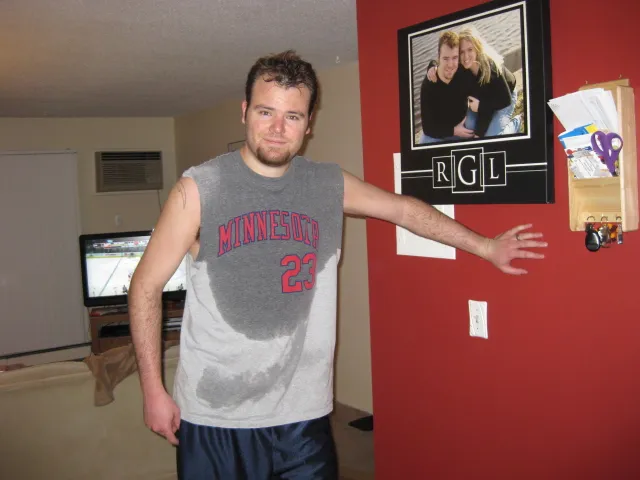
Photo: Tallguy1982, Public domain, via Wikimedia Commons
Let's set the scene. It's 11:30 PM on a Tuesday. You're in bed, scrolling through an ad that has somehow read your entire soul. The copy says something like "clinically inspired deep pressure stimulation for a calmer, more restful you." There's a woman in the photo who looks like she hasn't had a single anxious thought since 2014. She is draped in a blanket the color of a coastal spa. She is serene. She is, frankly, suspicious.
You bought the blanket anyway.
Of course you did. Because somewhere between the third paragraph of the product description and the customer review that said "I cried the first night I used it (in a good way)," you became briefly, magnificently convinced that $200 of glass beads stitched into microfiber was going to do what therapy, magnesium supplements, and three different meditation apps could not.
Reader, it did not.
The Optimism-to-Outcome Ratio of Wellness Spending
Here is a number that should humble all of us: Americans spend over $4.5 trillion annually on wellness. That includes everything from infrared saunas to adaptogenic mushroom coffee to, yes, weighted blankets sold as anxiety solutions. That is not a typo. That is trillion with a T, and a significant portion of it is being spent by people lying awake at 2 AM wondering why the thing they bought to help them sleep is not, in fact, helping them sleep.
The wellness industrial complex has figured something out about us, and that thing is this: we are wildly, almost heroically optimistic about objects. We believe, against all accumulated personal evidence, that the next purchase will be the one that cracks the code. The right blanket. The right pillow. The right sunrise alarm clock that simulates a Scandinavian dawn in your studio apartment in Cleveland. We are not buying products. We are buying the version of ourselves that finally has it together.
This is, to use a clinical term, bananas.
What Actually Happens on Night One
Night one with the weighted blanket is genuinely promising. You unfurl it across your body and there is, admittedly, something to the sensation. It does feel like being held. It feels grounding in a way that is hard to articulate to someone who hasn't tried it. You think: maybe the Instagram ad was right. Maybe this is the thing.
You fall asleep reasonably quickly. You feel cautiously victorious.
Night three is where the relationship gets complicated.
By night three, you have learned that fifteen pounds of blanket generates, conservatively, the thermal output of a golden retriever sitting directly on your torso. You wake up at 3 AM not because of anxiety — the anxiety is still there, it just moved to a different part of your brain — but because you are sweating in a way that feels medically significant. You kick the blanket off. You lie there, uncovered and annoyed, wondering if you can return something you've already sweat into.
You cannot. You checked the return policy before you even opened the box, as any anxious person would.
The Support Group Nobody Is Hosting
There is a very large, very quiet community of Americans who own wellness products that did not work. They are not talking about it loudly, because there is a specific shame that comes with having been persuaded by a blanket. But if you could gather them all in one room — the people with the weighted blankets balled up in the closet, the Theraguns used twice, the meditation cushions currently functioning as footrests, the blue-light glasses that live in a drawer — you would fill a stadium.
This is not a personal failure. This is a systemic one. The marketing around wellness products is engineered specifically to reach people at their most vulnerable and most hopeful. You weren't scrolling that ad at your best. You were scrolling it at 11:30 PM, already anxious, already exhausted, already primed to believe that something out there had the answer. The algorithm knew that. The algorithm has always known that.
The Real Product Being Sold
Here is what the weighted blanket is actually selling, and what every overpriced wellness gadget is actually selling: the feeling of having done something. The purchase itself is the action. It is proof to your nervous system that you are not just lying there suffering — you are addressing the problem. You are being proactive. The credit card transaction is, in a very real sense, the product.
This is not entirely irrational. Taking action, even symbolic action, does have a measurable effect on anxiety. The problem is that the effect wears off around the time the blanket arrives in the mail, which is also approximately when the next targeted ad finds you.
And so the cycle continues. The blanket gives way to the sound machine. The sound machine gives way to the magnesium gummies. The magnesium gummies give way to the app subscription that promises to rewire your nervous system in just ten minutes a day. Each one holds the promise of being the last one you'll ever need. None of them are.
So Now What
Look, we are not here to tell you to return the blanket. For some people, weighted blankets genuinely help, and good for those people — they are living their best thermally uncomfortable lives. We are also not here to tell you that spending money on your mental health is inherently foolish. It is not.
What we are here to say is that if you are lying under a $200 blanket, sweating and still anxious, you are not broken. You are not a failed consumer. You are just a person who got briefly convinced that a product could solve something that products are not really equipped to solve.
The blanket can't hold you the way you need to be held. It can't slow your thoughts down. It can't make the 3 AM spiral stop. It can just sit on your body and be heavy, which is sometimes nice, and sometimes just hot.
The good news is that you now own a very expensive, very cozy cat bed.
Every cloud, et cetera.