Congratulations, You've Turned Your Windowsill Into a Stock Portfolio
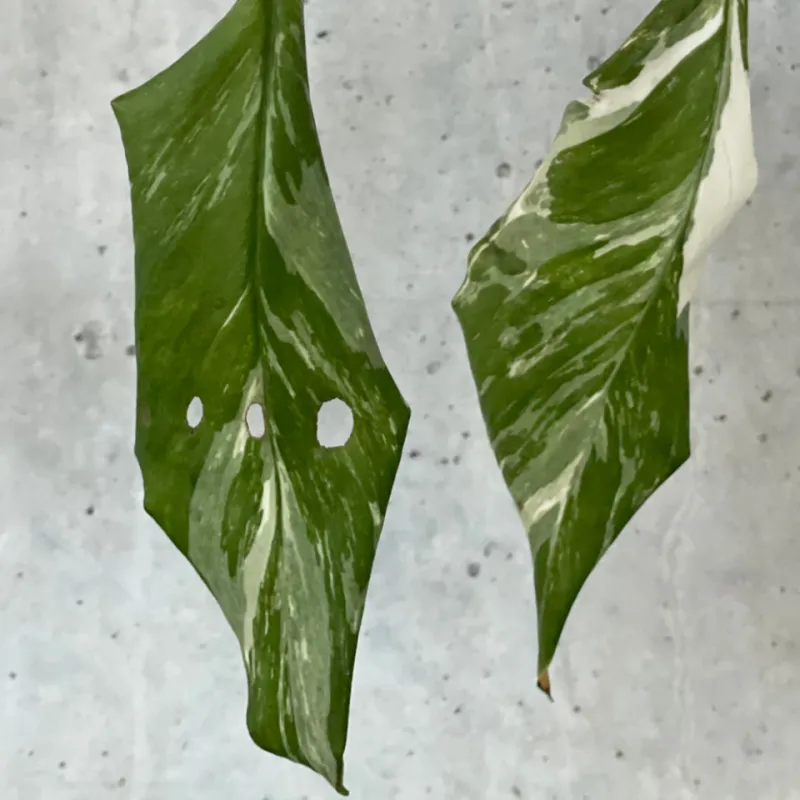
Photo: Plant Yeah, CC BY-SA 4.0, via Wikimedia Commons
Let's set the scene. It's a Tuesday evening. You're not on Robinhood. You're not watching CNBC. You're not stress-eating chips while staring at a candlestick chart. No, you are doing something far more serene — you are bidding $340 on a single cutting of a variegated Monstera deliciosa that has approximately four leaves, zero roots, and the structural integrity of a wet paper towel.
And you feel completely fine about this.
This is where we are, America. This is who we've become.
A Leaf By Any Other Name Would Cost Just As Much
For the uninitiated, here's a quick primer on the rare plant market, which is a sentence that would have caused a Victorian botanist to spit out their tea. Certain houseplants — particularly those with unusual variegation, meaning patches of white, yellow, or cream caused by a lack of chlorophyll — have become the Pokémon cards of the plant world. A standard Monstera deliciosa, the big leafy thing your aunt has had in her living room since 1987, costs maybe $20 at your local nursery. Fine. Normal. Reasonable.
A variegated Monstera deliciosa, however — same plant, just with some of the green missing, which is technically a mutation and arguably a flaw — can run you anywhere from $150 to well over $1,000 depending on the pattern, the seller, and what phase the moon is in, apparently.
And people are buying them. Enthusiastically. With the focused energy of someone who has done their research and is very confident this is not a mistake.
Instagram Did This. Instagram Did All of This.
You cannot talk about the rare plant market without acknowledging the Instagram pipeline that feeds it like a very aesthetic IV drip. Someone posts a photo of their Thai Constellation Monstera — that's another variegated variety, because there are several — bathed in golden hour light, sitting in a terracotta pot next to a linen throw pillow, and suddenly 47,000 people need one immediately.
The hype cycle is genuinely indistinguishable from what happens with sneakers, Supreme drops, or, yes, NFTs. A plant goes viral. Demand spikes. Prices explode. People who already own one suddenly feel like geniuses. People who don't own one feel a specific, embarrassing FOMO that they will later describe to their therapist as "just really wanting to connect with nature."
The plant influencer economy is real, it is thriving, and it has convinced a significant portion of the American population that spending $500 on something that might die if you look at it wrong is actually an investment in their mental wellness journey. Namaste.
The Speculative Bubble Your Potting Mix Can't Hold
Here's the part where we have to ask the uncomfortable question: is this a bubble?
Short answer: almost certainly yes, and it already partially popped.
During the pandemic, rare plant prices went absolutely feral. People were home, they wanted living things around them, they discovered plant communities online, and suddenly a Philodendron Pink Princess — a plant with pink splotches that sounds like it should be sold at a Lisa Frank store — was going for $400 a pop. The Monstera Thai Constellation peaked somewhere in the stratosphere. People were propagating cuttings, selling them on Etsy, and genuinely treating their grow tents like venture capital portfolios.
Then, as it always does, supply caught up. Tissue culture labs started producing variegated plants at scale. What was once a $600 Thai Constellation became a $60 Thai Constellation at Home Depot. Early adopters watched their leafy "investments" depreciate in real time. The vibe was, to put it gently, similar to checking your crypto wallet in November 2022.
And yet — and this is the part that earns this hobby a genuine place in the Are We Crazy Or What? hall of fame — people kept going. New plants replaced the old hype. The Monstera Albo. The Variegated Adansonii. The Philodendron Spiritus Sancti, which at its peak was selling for tens of thousands of dollars and has a name that sounds like it should be chanted by monks.
"But It's Not About the Money" — A Classic
Every single person who has spent more than $200 on a houseplant will tell you, unprompted and with great sincerity, that it's not about the money. It's about the passion. The community. The meditative joy of watching something grow.
This is beautiful. This is also exactly what people say about baseball cards, vintage wine, and cryptocurrency.
The tell is in the language. Plant people talk about their collections the way investors talk about portfolios. They discuss "acquiring" rare specimens. They track price histories. They know which sellers are reputable and which ones are "shady" — an actual term used in plant Facebook groups with the gravity of a SEC violation. They celebrate when a cutting "roots out" with the same energy as a stock hitting a new high.
Nobody who is purely doing something for love develops this vocabulary. That's a market participant. That's someone who has, consciously or not, tied their emotional wellbeing to the fluctuating value of a chlorophyll-deficient tropical leaf.
The Part Where We Admit We Kind of Get It
Look, before we get too smug about all of this, let's be honest: at least the rare plant market produces something tangible. Something alive. Something that, unlike an NFT, cannot be right-clicked and saved by a stranger.
There's a version of this hobby that is genuinely lovely — people learning about horticulture, building real communities, developing patience and care through the slow, humbling process of keeping a difficult plant alive. That's not crazy. That's actually kind of wonderful.
The crazy part — the beautiful, uniquely human, completely unhinged part — is the moment it stops being about the plant and starts being about the price. The moment you catch yourself checking the Etsy market value of your Monstera before you water it. The moment you describe a leaf mutation to a non-plant person and watch their eyes glaze over while you're still talking about "fenestration patterns" and "high variegation ratios."
That's the moment you have, without any paperwork or formal announcement, become a commodities trader who works from a grow light in your spare bedroom.
So Are We Crazy, Or What?
Yes. Emphatically yes. But in the most charming, harmless, slightly financially irresponsible way imaginable.
If you're going to build a speculative bubble, building it out of living plants that produce oxygen and look beautiful in a ceramic pot is honestly one of the more defensible choices available to us as a society. It's not GameStop. It's not a JPEG of a bored cartoon ape. It's a plant.
It's just also, quietly, accidentally, unmistakably — a financial instrument you're keeping in your kitchen window and watering every Thursday.
Raise your eyebrow. Adjust your grow light. And maybe, maybe, think twice before dropping four hundred dollars on a cutting that has two leaves and a dream.